5 Keys to Setting the Tone as a New Leader

Whether you’re a first-time leader or an experienced manager in a new role, the first 100 days are critical. People are watching you closely which can be intimidating but it also can be used to your advantage.

“As a leader you set the tone for your entire team.” Colin Powell

Setting the tone is imperative during these early days. Here are five things you can do to let people know what type of leader you are.

Create a buzz. Do something to get everyone talking. Make it extreme so the message is clear. This is something I always do. In one manufacturing plant, I had the maintenance team paint over all the signs for the reserved parking spaces for managers, including mine. The message was simple, there is no special treatment for managers. We are in this together.

Set the example. Your minimum behaviors will be your team’s maximum performance. If you expect people to be on time, you need to be on time. If you expect managers to get out of their offices, you need to be out of your office. If you expect people to wear their safety equipment, you need to wear your safety equipment. It’s simple. Just as children follow a parent’s lead, your team will take cues from you.

“The reality is that the only way change comes is when you lead by example.” Anne Wojcicki

Signal your priorities. What’s important to you will be seen by your team. If you spend the first hour of the day on your computer and not with your team, they will see that. They will assume they are not as important as your e-mail. If you spend a meeting constantly looking at your phone, they will assume their presentation is not a priority for you.

“You are the leader and the troops will reflect your emotions.” Colin Powell

Establish the mood. We all know attitude is contagious. Regardless how you feel, you need to be upbeat and optimistic around your team. You still need to be empathetic when you have serious issues to deal with, but if you are consistently upbeat and in good spirits, the team will demonstrate the same. In the same respect, if you are quiet, unresponsive, angry, abrasive, sarcastic, or hidden, the life will get sucked out of your team.

“See and be seen. Get out of your office, walk the talk, make yourself visible and accessible.” Bill Marriott

Be open, available, and visible. Go to where your people are. Greet them every day. Show interest by actively listening and being open. Engage them on the subjects they care about. Your team will see you care and are interested in their thoughts and opinions. They will see you as open and willing to listen. They will be more likely to share their true feelings about the challenges they face.

Setting the tone early is critical. All eyes are on you as the new leader, so make it count. Create a buzz, set an example, show your priorities, establish the mood, and be present. These activities will let your team know what kind of leader you are and what your expectations are. This will help you down the line when you need their help to tackle the tough issues.

To learn more about how respected leaders set the tone, read Colin Powell’s leadership book, It Worked for Me: In Life and Leadership.

Let me know what you think in the comment section below.

Great Leaders Aren’t Afraid to Love Their Teams

One frustrating thing I see in leaders from time to time is a negative attitude towards people. Many choose a career in leadership who don’t like dealing with people. Unfortunately, they usually find they are less effective as a leader with this mindset. The reason is that leadership is inherently a people business.

“Leadership is a people business.”

The entire role of a leader is to motivate a team of people towards accomplishing an objective. Great leaders know that. They also know people are messy. People have issues, problems, emotions, quirks, hang-ups, baggage, and can be unpredictable. A great leader can see past the flaws, love their people, and motivate them to do great things. In my opinion, you can’t be a great leader if you don’t love people.

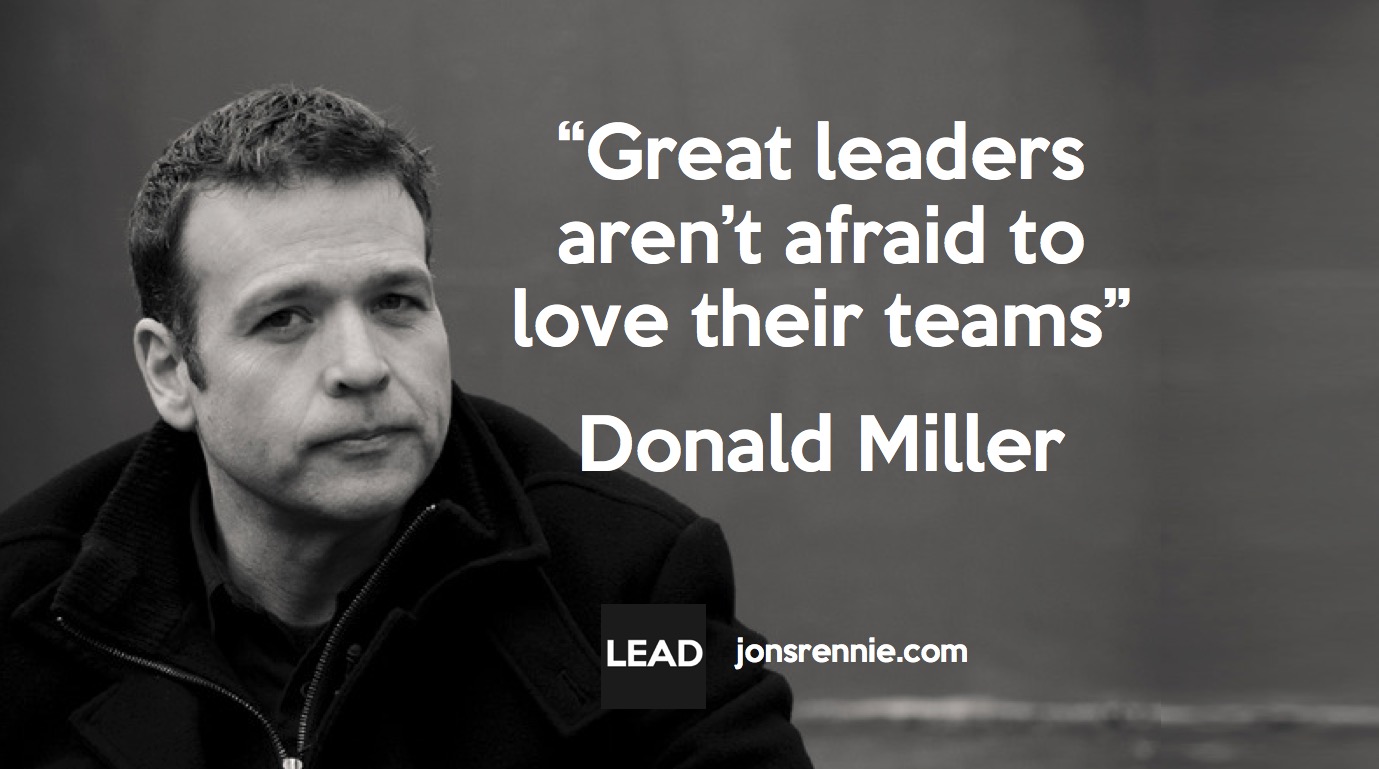
“Great leaders actually love their teams more than they love themselves.” Donald Miller

Donald Miller, founder and CEO of Storybrand, sees it the same way. I like his thoughts on this subject as he reflects on the culture he built at his company. One of the core values he put in place was to “make his employees’ dreams come true by serving clients faithfully.”  I thought it was interesting that he purposely intertwined serving customers with the dreams of his employees. In his view, loving your employees means helping reach their full potential.

“Great leaders can see the greatness in others when they can’t see it themselves and lead them to their highest potential they don’t even know.” Roy T. Bennett

Miller credits the growth of his company to the “secret ingredient” of love. Things changed at his company as they started to live out these core values. As he loved and respected his employees, they loved each other, and they worked as a team to better serve customers. He built a culture of respect with a foundation in love.

He explains that love can be quite scary, though:

Love doesn’t give you complete control over people. Love means you can’t disrespect them when you’re frustrated. Love means you really understand that people aren’t just a cog in a wheel. Love means you have to allow people to hurt you and let you down, and they will, just as you will them. But love also means you forgive, you don’t keep score, you show grace and you protect each other at all costs.

 And sometimes, protecting people means you have to let some people go. People that don’t fit into the culture or try and take advantage of the environment need to be dealt with. The sooner you address it, the better it is for that employee and the rest of the team.

He has two fundamental rules which has helped him create a culture of love and respect:

  1. Hire people who are better, smarter and faster than you.
  2. Never mess with their hearts.

What do you think? Does love belong in the workplace? Can a culture of love and respect boost a company’s performance? How will employees react when they feel their boss truly cares about their hopes and dreams? Why don’t more leaders practice this? Let me know in the comment section below.

The Truth about Authenticity


While fake news is often hard to spot, phony advertising, inauthentic companies, and fake people aren’t.

I was listening to my favorite podcast the other day and I heard it. I wasn’t listening for it, but it was obvious. Commercials on podcasts usually involve the host telling you how great a product or service is. It’s typically something they have used personally and they give you their own perspective. It’s almost like an endorsement, so advertisers normally give the host freedom to ad-lib. The result is an advertising segment that seems genuine and authentic.

That’s why it stood out to me when the host of the podcast read this advertisement segment verbatim. It was for the new Toyota CH-R. The ad seemed like it was written by a high-priced Madison Avenue firm. Every word was carefully selected, the message was perfectly crafted, and it was likely focus-tested to provoke a picture-perfect response. The host even read the flawless, well-written legal disclaimer at the end. To me, it sounded phony.

In the podcast world of personal-endorsement-style advertisements, this one felt fake. It didn’t seem truthful or genuine. It was over-produced, over-engineered, and too perfect. It wasn’t real.

“There’s authenticity in a first take.” Mike Rowe

Mike Rowe of Dirty Jobs fame would agree. He made a living off being “authentic.” He said, “Dirty Jobs didn’t resonate because the host was incredibly charming. It wasn’t a hit because it was gross, or irreverent, or funny, or silly, or smart, or terribly clever. Dirty Jobs succeeded because it was authentic.” The show was the first of its kind. There was no script, no rehearsal, and only one take. They turned the cameras on and Mike responded and reacted to his environment. It was genuine and people loved it.

“I believe the enemies of charm are deliberateness in much the same way I would argue that the enemies of authenticity are production.” Mike Rowe

Companies can also be inauthentic when they aren’t true to their message. Think about Subway restaurants. They’ve used the advertising slogan, “Eat Fresh,” since 2002. They came under fire when it was discovered they used azodicarbonamide in their bread as a conditioner. Food blogger Vani Hari, of the popular food blog Food Babe, originally drew public attention to this issue. She revealed that azodicarbonamide was the same chemical used in yoga mats and shoe rubber. In 2014, after public pressure grew, Subway stopped using the chemical in their bread recipes.

But the damage to Subway was done. Subway’s sales fell. They lost 3% in 2014, despite opening 778 new stores. They faced eroding public perception regarding the quality of their food while still using the “Eat Fresh” slogan. The main reason they lost consumer confidence was because they were seen as phony and inauthentic. You can’t claim “Eat Fresh” and use a yoga mat chemical in your bread.

People can be fake as well. People who make promises with no intention to keep them, those that make friendships only for personal gain, or those that have hidden agendas are seen as shallow and phony. You can probably name people with these qualities where you work. They can be successful in the short term but only until people learn their true character. Then, no one wants to work with them.

“People with good intentions make promises, but people with good character keep them.” Anonymous

In a world where we are surrounded by phony people and messages, how can we be more authentic? Let me suggest three things.

Be true to the first take. Avoid over-processing and over-engineering your message. A product training video, for example, that has a few mistakes seems more real than one that has been carefully edited. A quick, witty tweet delivered at the right time will get more attention than a perfectly polished post. We are bombarded daily with highly-engineered, focus-group tested messages. An honest first-take is refreshing and seems more authentic.

Be true to your company promise. What does your company stand for? What is the brand promise? Whatever it is, make sure you are delivering to that promise. If you commit to 24 hour deliveries, make sure you are built for speed. If you promise the “lowest prices,” make sure you know that’s true. If you claim “eat fresh,” then know what’s in your recipes. Being true to your brand promise will make you appear more authentic.

Be true to others. Nobody wants a fake friend. Be real. If you make a promise, deliver on it. Build relationships based on mutual respect not hidden agendas and personal gain. Be there for people in the good times as well as the bad. Put others ahead of yourself. Don’t talk behind their backs. Show respect for everyone on your team. Being true to others and being a person of character will make you more authentic.

Let’s get rid of fake news and, while we’re at it, let’s get rid of phony advertising, untruthful companies, and fake people. Authenticity is rare. We will stand out if we embrace reality and stop being so over-engineered on fake. Embrace your genuine self, be original, and see what happens. It certainly worked for Mike Rowe.

What do you think? Does authenticity stand a chance today? Are there other reasons why “Dirty Jobs” had such mass appeal? How can we employ authenticity in our messaging? What are some other examples of authentic or inauthentic companies? What was the result? Let me know in the comment section below.