Disasters Happen when Leadership Fails

When leaders fail to lead, the results are often devastating.

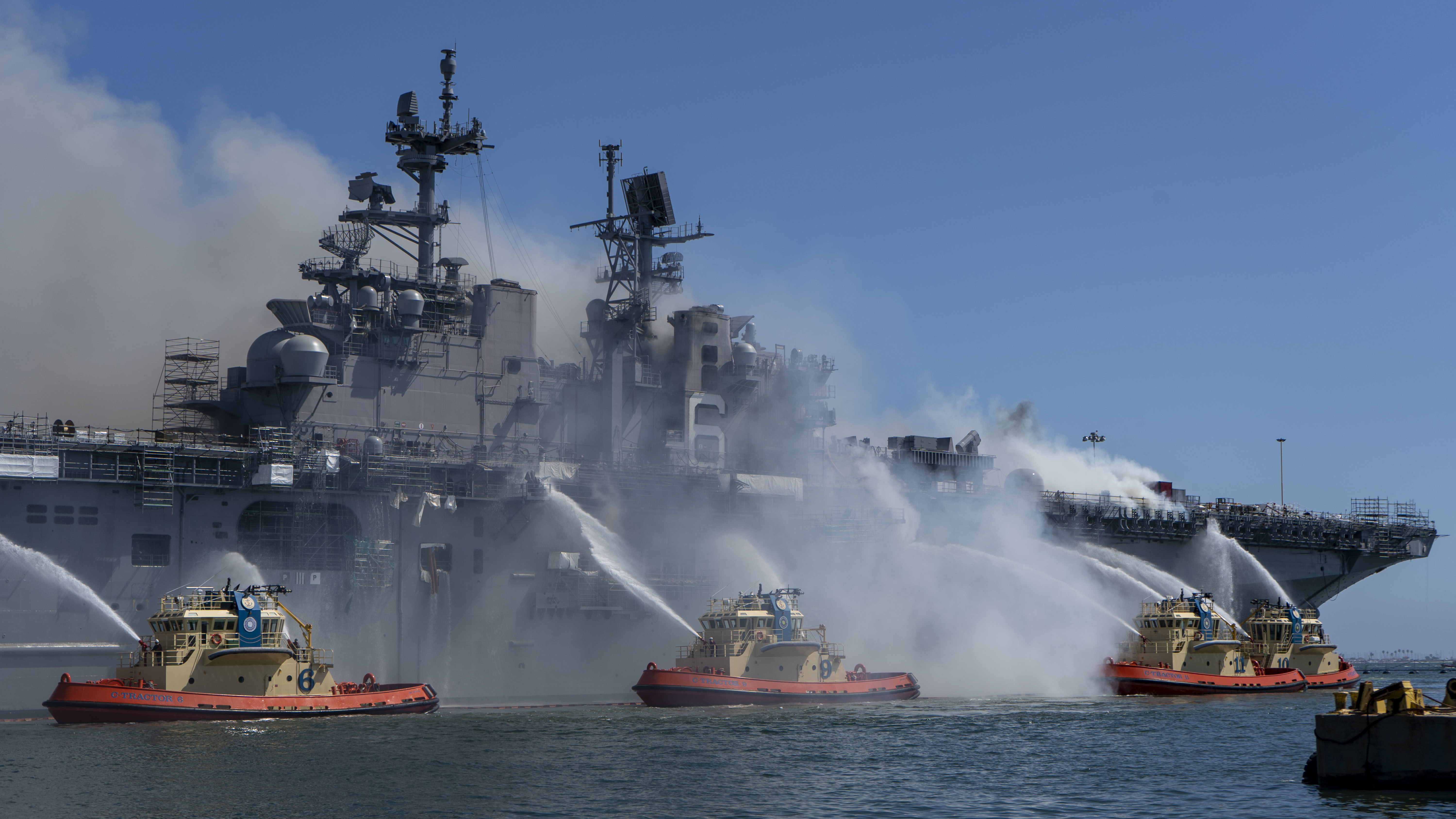
On July 12, 2020, an arsonist set a fire aboard the amphibious assault ship USS Bonhomme Richard (LHD 6) at Naval Base in San Diego. The fire burned for four days, injured 63 people, and resulted in a complete loss of the ship.

This past week, the military released a 400-page report stating that 36 individuals, including the ship’s captain and five admirals, were responsible for the 3.5 billion dollar loss. The report concluded that “Although the fire was started by an act of arson, the ship was lost due to an inability to extinguish the fire.”

As a former naval submarine officer, I was shocked to learn that crew and shipyard personal did not know how to fight this fire. According to the report, “the response effort was placed in the hands of inadequately trained and drilled personnel.”

[bctt tweet=”When an organization fails, it’s always a failure of leadership.” username=”jonsrennie”]

In my experience, the only way a ship’s crew could be inadequately trained to fight a fire is that the captain failed to make it a priority.

I should know because I’m a trained navy firefighter. 

Every member of my crew was when I served. We were all trained to fight fires. It was part of our basic submarine training and something we drilled on constantly.

A fire on a navy vessel is one of the most dangerous things that could happen on board. Smoke can quickly fill compartments and asphyxiate sailors. The heat and flames can spread to weapons, volatile materials, and critical systems, creating catastrophic damage. Small fires become big fires. A massive fire can quickly incapacitate the crew and disable the ship as it did with the Bonhomme Richard.

That’s why we learned to rapidly attack the fire when it was still small and why we trained so hard in firefighting.

When I served on the USS Tennessee, I must have put more than five hundred simulated fires. Fighting fires was second nature to us. Our crew was exceptionally proficient at firefighting because our captain made it a priority, and he trained us hard.

Our captain knew that he was responsible for both the mission and the crew. He knew that a fire on board put both of those priorities in jeopardy.

[bctt tweet=”Leaders are responsible for both the mission and the crew.” username=”jonsrennie”]

In contrast, the crew of Bonhomme Richard took two hours to get water onto the fire and had failed 14 consecutive fire drills before the blaze. They were ill-trained and ineffective due to a failure of leadership.

The captain and senior officers failed their crew and the Navy.

They didn’t place a priority on the mission and the crew. They were distracted by other activities.

Think about this story as it relates to your leadership situation.

What are the things that can quickly disable your organization and adversely affect your mission and people?

Do your employees know what to do when that happens?

Have they been adequately trained?

When an organization fails, it’s always a failure of leadership, and the results can be devastating. The fire on the Bonhomme Richard is just another cautionary tale of what happens when leaders fail to lead.

In my new leadership book, All in the Same Boat, there is a chapter called “Run to the Fire.” I talk about the essential leadership lessons I learned as a navy firefighter and how I applied those lessons to business. Check it out here.

[U.S. Navy photo by Mass Communication Specialist 3rd Class Christina Ross/Released]

The Silver Lining of a Struggle

I’m not a runner, but I ran six half-marathons once.

Growing up in New England, it was always a dream to one day run the Boston Marathon but training for and running six half-marathons was all I needed to realize how difficult that would be.

I learned that running is hard and running long distances is even harder.

Although I only conquered the 13.1-mile race, I learn a lot about myself and what I could do if I just didn’t quit.

The truth is, long-distance running is not about bragging rights, personal records, t-shirts, or race medals. It’s about challenging yourself to do something difficult.

Most people only see what happens on race day – they don’t witness the months of training and the hours spent grinding out the miles day after day.

There is excitement the day you sign up for a race and the day you finish a race.

But the real work, the real struggle, and the real learning are all done in the middle.

[bctt tweet=”The real work, the real struggle, and the real learning are all done in the middle.” username=”jonsrennie”]

In Donald Miller’s book, A Million Miles in a Thousand Years, he talks about the importance of the struggle:

“The reward you get from a story is always less than you thought it would be, and the work is harder than you imagined. The point of the story is never about the ending, remember. It’s about your character getting molded in the hard work of the middle.”

As Miller suggests, the hard work in the middle of any difficult challenge is more important than the ending.

[bctt tweet=”The middle of any difficult challenge is more important than the ending.” username=”jonsrennie”]

Why – you ask? Because…

The struggle builds character. An easy life is one that doesn’t change you. Challenge brings about change. The struggle requires determination, courage, intensity, and perseverance. Some days it takes everything to keep going especially when the end seems nowhere in sight.

The struggle builds relationships. Persevering through a difficult challenge with a team or another person builds strong bonds that last a lifetime. When you suffer and struggle together, you build a defining moment in your relationship. You build mutual respect.

The struggle builds the story. Every great story has a hero’s journey. The main character must struggle and overcome a major obstacle or challenge. As an audience, we become endeared to the hero as they endure hardships and trials. This is the same with people and organizations. We are attracted to those who have faced trials and have overcome them.

As we find ourselves in the middle of this COVID struggle with seemingly no end in sight, we need to realize that we’re in a good place.

Just like being on the ninth mile of a half marathon on a bridge in the cold, windy, pouring rain – this is when we find out who we really are. If we just don’t quit, we’ll learn we can do amazing things.

So, if you’re going through hell right now, don’t stop. Keep going!

Remember these words from Theodore Roosevelt:

“Nothing in the world is worth having or worth doing unless it means effort, pain, difficulty… I have never in my life envied a human being who led an easy life. I have envied a great many people who led difficult lives and led them well.”

So, stay strong and stay in the fight.

Deep Leadership Podcast

If you want to gain some insights on how to power through this crisis, listen in on my joint podcast with fellow podcaster, Jason Oates.

The Perfect Pandemic Pivot

I have given several webinars over the past few weeks on leading during a crisis and one of the topics I like to discuss is making a pivot. Once you understand how this pandemic affects your team, your organization, and your industry, you need to chart a new course.

But – and this is really important – you need to stay true to your mission.

[bctt tweet=”If you pivot, you need to stay true to your mission.” username=”jonsrennie”]

Let me give you an example.

You’ve probably heard of the company, Life is Good.

It’s a lifestyle brand founded in 1994 and is best known for optimistic T-shirts and hats, many of which feature a smiling stick figure named Jake.

It’s probably not surprising to learn their mission is to “spread the power of optimism.”

I’ve watched them make a pivot during this COVID crisis and you can see it too. On the front page of their website, every T-shirt is related to the global pandemic but in a hopeful, optimistic, and positive approach.

For example, you can get a shirt with golden retrievers on a Zoom call or Sasquatch as the social distance world champion.

They call these shirts, “lighthearted tees for uncertain times,” and they are consistent with their mission to spread the power of optimism even in a global pandemic.

You might be thinking, that’s great Jon but I don’t own an optimistic T-shirt company, how can I make a pivot?

Good question!

I recently had Philip Freeman as a guest on my podcast. He is the founder of Murphy’s Naturals, a company that manufactures natural products for outdoor living – think bug repellent. I wanted to have him on the podcast because of the pivot he made in his business.

And…how it was entirely consistent with his mission statement.

Murphy’s Naturals’ mission is to celebrate nature and inspire good through quality natural products. They believe in “doing others good.”

During this pandemic, Philip quickly realized the world desperately needed hand sanitizer and he had the assets and people who could produce this essential product.

So, he and his company made a pivot and began to manufacture hand sanitizer.

But not just for any customer either. Philip’s company ended up becoming a supplier to the U.S. Navy who desperately needed this essential product.

And true to the company’s mission, Murphy’s Naturals’ hand sanitizer is 99.99% natural.

Inspiring good through quality natural products is not just a mission statement in a dusty binder on a shelf for Murphy’s Naturals, it’s something that is lived every day, even in a global pandemic.

[bctt tweet=”A mission statement is something that is lived every day, even in a global pandemic.” username=”jonsrennie”]

So, what about your organization? What pivot are you considering or have you done already?

More importantly – is it consistent with your mission?

Pivoting in a crisis is important but pivoting with a purpose is absolutely critical to maintaining your company’s authenticity.